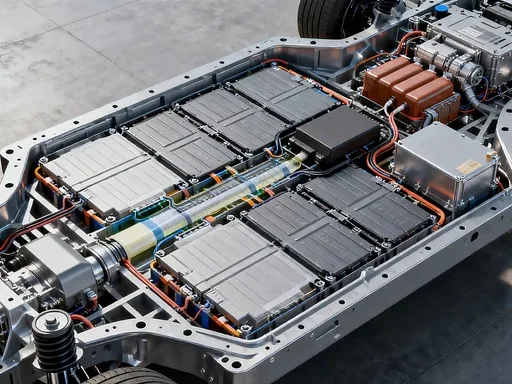
Power Batteries: The Core Competitive Advantage of Chinese New Energy Vehicles in Global Markets
🔋 1. Global Market Landscape: China Leads the Battery Era
The global electric vehicle battery market is undergoing a profound transformation, and Chinese manufacturers are at the center of this shift. In 2025, global EV battery installations reached 1,187 GWh, a year-on-year increase of 31.7%. Among this total, Chinese battery manufacturers accounted for an overwhelming share, with seven Chinese companies ranking in the global top 10 and collectively holding a 72.4% market share in the first half of 2026.
At the forefront is CATL (Contemporary Amperex Technology Co., Limited), which installed 464.7 GWh in 2025 — a 35.7% year-on-year increase — securing a 39.2% global market share and its ninth consecutive year as the world's number one battery supplier. Following closely is BYD (FinDreams Battery), ranking second globally. Together, CATL and BYD command 54.3% of the global market — more than all Japanese, Korean, and European competitors combined.
Key Insight: For every two EV batteries installed worldwide in 2026, more than one comes from a Chinese manufacturer. This dominant position is not accidental — it is built on decades of sustained R&D investment, vertical supply chain integration, and large-scale manufacturing efficiency.
⚡ 2. Technological Innovation: Breaking Records in Charging Speed and Range
Chinese battery manufacturers have moved beyond cost competition to lead the world in core technology breakthroughs. In April 2026, CATL held its largest-ever technology launch event, unveiling a new generation of battery products that redefined industry benchmarks.
Shenxing Ultra-Fast Charging Battery — Eliminating Range Anxiety
The third-generation Shenxing Ultra-Fast Charging Battery set a new global record for charging speed:
- Full charge at room temperature in just 6 minutes
- 10% to 98% charge in 6 minutes 27 seconds
- Peak charging rate of 15C
- Over 90% capacity retention after 1,000 charge cycles
This means a typical EV can add over 400 km of range during a short coffee break — effectively matching the refueling speed of conventional gasoline vehicles.
Qilin Battery — Pushing Energy Density to New Heights
The third-generation Qilin Battery addresses the "range anxiety" challenge:
- Cell energy density of 280 Wh/kg
- Vehicle range exceeding 1,000 km
- Battery pack weight of only 625 kg — 255 kg lighter than equivalent LFP solutions
- Supports 10C-level fast charging
The Qilin Condensed Battery takes this even further, achieving an energy density of 350 Wh/kg and a range of 1,500 km — the first application of aviation-grade condensed technology in passenger vehicles.
BYD Blade Battery — Safety Through Structural Innovation
BYD's Blade Battery revolutionized LFP (lithium iron phosphate) battery design:
- Ultra-long cell structure with CTB (Cell-to-Body) integration
- Eliminates traditional modules, improving pack space utilization
- Passed the nail penetration test without fire or explosion
- Second-generation Blade Battery entered mass production in 2026
Sodium-Ion Batteries — The Next Frontier
CATL's sodium-ion battery technology opens new possibilities for cost-effective, cold-climate EVs:
- Cell cost reduced to 0.45 RMB/Wh, with potential for further 20-30% reduction at scale
- Energy density of 175 Wh/kg
- Stable discharge at -50°C extreme cold
- Scheduled for mass production by end of 2026
💰 3. Cost Advantage: The Price Gap That Drives Global Competitiveness
One of the most significant advantages of Chinese batteries is their cost efficiency. According to BloombergNEF's December 2025 survey:
- China: Average battery pack price of $84/kWh
- North America: Approximately $121/kWh — a 44% premium over China
- Europe: Approximately $131/kWh — a 56% premium over China
For a typical 60 kWh battery pack, this translates to a per-vehicle cost advantage of approximately $2,200–$2,800 for Chinese EVs compared to their Western counterparts. This cost gap is a primary driver behind the global competitiveness of Chinese new energy vehicles.
This advantage is underpinned by China's control of the battery supply chain:
- Over 90% of global refining, cathode, and anode production is based in China
- Vertical integration from raw material processing to cell manufacturing to pack assembly
- Large-scale production capacity — CATL alone reached 772 GWh of global production capacity in 2025
🌍 4. Global Expansion: From Domestic Dominance to Worldwide Presence
Chinese battery leaders are rapidly expanding their global footprint to serve international OEMs and meet local content requirements.
CATL: Global Manufacturing and R&D Network
- Overseas revenue accounted for nearly 35% of total revenue in 2025, up from approximately 30% in 2024
- Supplies global OEMs including Tesla, BMW, Mercedes-Benz, Volkswagen, Ford, and Hyundai
- R&D investment reached 22.1 billion RMB in 2025, with over 90 billion RMB invested in research over the past decade
- Maintained operating margins of 10-15% annually between 2020-2024, and 18% in 2025 — demonstrating that technology leadership and profitability can coexist
BYD: Vertical Integration Powerhouse
- FinDreams Battery supplies the full BYD EV lineup plus external customers including Toyota and Stellantis
- Production capacity exceeding 350 GWh
- Blade Battery technology licensed to multiple international partners
🤝 5. What This Means for Global Partners
For overseas distributors, fleet operators, and consumers, the Chinese battery advantage translates into tangible benefits:
For Distributors and Importers:
- Access to proven, mass-produced battery technology with billions of kilometers of real-world validation
- Competitive vehicle pricing driven by lower battery costs
- Comprehensive warranty coverage — typically 8 years/150,000 km for traction batteries
- Growing local parts and service support networks in key markets
For Fleet and Commercial Customers:
- Lower total cost of ownership (TCO) due to reduced energy costs and maintenance requirements
- Fast-charging capability minimizing fleet downtime
- Long cycle life ensuring battery performance over extended service periods
- Battery health monitoring and management systems
For End Consumers:
- Longer driving ranges at accessible price points
- Ultra-fast charging reducing wait times at charging stations
- Enhanced safety through LFP chemistry and structural innovations like Blade Battery
- Continuous OTA updates optimizing battery performance over vehicle lifetime
🚀 6. Conclusion: The Battery Advantage That Powers Chinese EVs
The global EV market is increasingly defined by battery technology — and Chinese manufacturers have established a commanding lead in market share, technological innovation, cost efficiency, and global reach.
From the 6-minute full-charge Shenxing battery to the 1,500 km range Qilin Condensed battery, from the safety-proven Blade Battery to the cold-climate sodium-ion technology, Chinese battery innovation is reshaping what consumers expect from electric vehicles.
The Bottom Line: When you choose a Chinese new energy vehicle, you are not just choosing a car — you are choosing the world's most advanced, cost-effective, and proven battery technology that powers over 70% of electric vehicles on the planet today.